You’ll spot it when the centre of the mattress starts to dip long before the edges do. That’s not just the child’s weight—it’s the foam itself giving up, its internal structure compromised by moisture it can’t release. In Singapore’s climate, where humidity often hovers around 80% or more, that damp sea breeze drifting into an east coast flat isn’t just a nuisance; it’s a slow-acting solvent for low-grade mattress materials.
Cheaper polyfoam is the main culprit. It’s porous enough to let that moisture seep in but lacks the resilience to push it back out. The foam core retains that dampness, which gradually degrades the polymers that give it springback. You end up with a mattress that feels perpetually limp, offering less and less support for a growing spine over time. It’s a hidden cost, one that forces a replacement cycle much sooner than the warranty might suggest.
For parents, the maths is straightforward. A kids mattress that can’t breathe becomes a sponge, and every humid monsoon season adds to its load. You might have a water-repellent cover for accidents, but that only addresses surface spills. The real battle happens invisibly, inside those foam layers where the air doesn’t circulate. Without a material that actively wicks and disperses moisture, you’re essentially trapping it against the core.
There’s a clear exception, of course. If you’re in a heavily air-conditioned space year-round, the ambient humidity is controlled, and the risk drops significantly. But for the majority in typical HDB flats with natural ventilation, assuming your indoor air is dry enough is a gamble. The proof is in the premature sag, the dip that forms right where your child sleeps night after night.
So when you’re evaluating options, look beyond the cover and the quilting. Ask about the foam’s breathability and its closed-cell structure. A material that resists moisture retention isn’t just about comfort; it’s about ensuring the support you paid for actually lasts through the entire childhood growth spurt. Otherwise, you’re buying a mattress with a built-in expiration date, set by our weather.
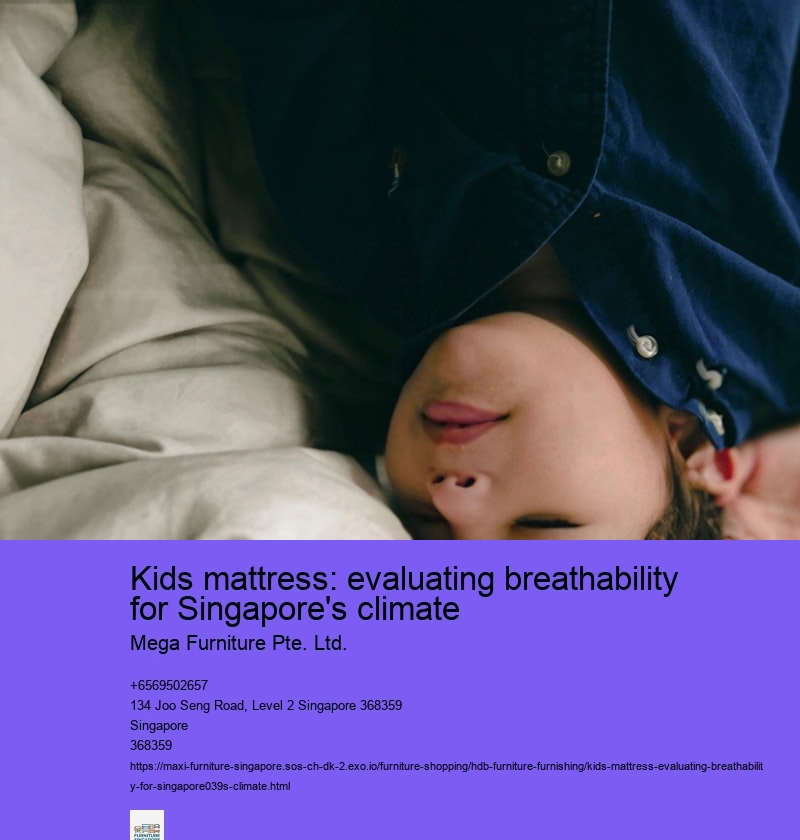
A child’s mattress that feels wonderfully supportive for an adult in a showroom can turn into a heat trap in a 12 sqm common bedroom. Latex and memory foam are prized for contouring and pressure relief, but their dense cell structures are insulators. They need body weight to sink and allow air circulation—an adult’s weight does that, but a child’s lighter frame doesn’t press deep enough. The material just sits there, trapping the child’s body heat against the surface all night.
You’ll notice this most in those non-air-conditioned rooms. The fan circulates the room’s air, but it can’t reach the micro-climate forming right under your kid. It creates a localised pocket of warmth that builds up steadily, especially during our humid stretches. What you get is a restless child, flipping over constantly to find a cool spot, and a mattress damp with sweat by morning. That’s not comfort—it’s a recipe for disrupted sleep for everyone.
Now, this doesn’t mean you must avoid these materials entirely. In a master bedroom with the air-con on all night, the effect is minimised. But for a kid’s first proper bed in a typical BTO common room, breathability has to trump that luxurious sink-in feel. Look for layers designed to channel air, or consider a hybrid construction where the memory foam or latex is a thinner comfort layer atop a naturally breathable core. The support can still be firm for their spine, but the heat won’t pool.
The one real exception is if your child’s room is permanently climate-controlled. Then, the thermal properties matter less, and you can prioritise pressure relief. For most of us in 4-room flats where the common bedrooms rely on fans, that dense foam becomes a liability. A mattress that sleeps cool is non-negotiable—no point having the “best” material if it makes your kid toss and turn until dawn.
That waterproof layer on a kids mattress is a solid sheet of plastic, usually polyurethane or a similar membrane. It sits right under the fabric, and its job is to block any liquid from reaching the core. The trade-off is immediate: what stops a juice spill also stops air movement completely. You get a dry mattress interior, but the sleeping surface itself becomes a sealed environment where nothing escapes. In our humidity, that sealed surface is where the problem starts for a sleeping child.
Even without a major accident, a child's body releases a surprising amount of moisture overnight through perspiration. In a typical 4-room BTO bedroom with limited cross-ventilation, ambient humidity adds to that load. A breathable core material like latex or pocketed springs is rendered useless when the cover itself doesn't breathe. The moisture has nowhere to go, so it condenses on the cooler underside of that impermeable layer. The child ends up sleeping on a slightly damp, clammy surface no matter how advanced the mattress interior claims to be.
Manufacturers love to tout airflow channels and open-cell structures in their foam or spring systems. For an adult mattress without a full waterproof barrier, those features actually matter. With a kids mattress designed for accident protection, that marketing becomes almost decorative. The impressive breathability of the core is completely isolated from the sleeper by the waterproof shield. You're paying for a climate-control system that's permanently switched off, which is a frustrating bit of specs-washing parents rarely catch.
The result isn't just a theoretical issue; it translates to real discomfort that disrupts sleep. A child who feels hot and sticky will toss and turn more, trying to find a cooler spot on the sheet. This constant fidgeting prevents the deep, restorative sleep their growing bodies and brains need. Over time, that accumulated nightly disturbance can affect mood and concentration during the day. The very feature meant to protect the mattress ends up undermining its primary function: providing supportive, comfortable rest.
The one real exception is for a child who is still very prone to frequent night-time accidents. In that specific, temporary phase, the absolute protection might outweigh the breathability sacrifice—you just change the sheets more often. For most children past that stage, a water-resistant treatment that repels spills but still allows some vapour passage is a far smarter buy. Look for covers that use a technical fabric with a durable water repellent finish, not a solid plastic sheet. That way, you get practical protection without creating a humid microclimate on the bed surface.
A mattress that sits only a handspan off the floor might seem like a smart safety choice, but in our climate, that low profile can create a microclimate all its own. Cooler, denser air tends to pool near the floor, especially in ground-floor units or older resale flats where ventilation isn’t optimal. That air holds moisture, and when it comes into constant contact with a cool surface—like the underside of a mattress or the tiles beneath it—you get condensation. This isn’t just about a bit of dampness; it’s a steady invitation for mould and mildew to take hold in the very materials meant to support your child’s sleep.
Tiled floors, common throughout Singapore homes, are particularly good at staying cool. Place a low-profile kids’ mattress directly on a slatted base or a simple platform, and you’ve essentially created a sandwich. The cool tile below, the mattress above, and that thin band of still, humid air trapped in between. Over time, this concentrated moisture doesn’t just linger on the floor—it can wick upwards into the mattress core. Even with water-repellent covers on top, the base layers are vulnerable.
The risk isn’t uniform for every flat. If your child’s room is on a high floor with cross-breezes, or if you’re militant about air-con and dehumidifiers, you might never see an issue. But for those in ground-floor units, or older blocks where the walls themselves seem to breathe humidity, it’s a real consideration. That cool, damp air at ankle level is a constant, silent presence during our monsoon seasons.
So, what’s the move? You don’t have to abandon the safety of a low bed frame. Instead, think about breaking that seal. Opt for a bed base with generous, open slats instead of a solid platform, allowing for air movement underneath. Consider a moisture barrier mat designed for mattresses, or simply make a habit of lifting the mattress periodically for a check and a wipe-down. It’s a small adjustment in routine that counters a big, soggy problem—ensuring the bed stays a healthy foundation, not a sponge.
" width="100%" height="480">Kids mattress: evaluating breathability for Singapore's climateA mattress spec sheet can tell you the foam density and fabric type, but it can't tell you how it'll feel under a child's elbow or knee. That's a hands-on job. The difference between a firm, supportive core and one that's just hard, or between a cover that breathes and one that traps heat, is something you need to gauge with your own pressure. For that, you really need a few models lined up in the same air-conditioned space.
You'll want to press down firmly with the heel of your hand, mimicking the concentrated weight of a sleeping child's hip or shoulder. A good kids' mattress should resist that pressure with a resilient push-back, not just a surface stiffness. Then run your fingers over the fabric weave—a tighter, smoother cover might feel more durable, but a slightly open, textured one often allows better air circulation, which is a non-negotiable for our climate. Seeing the Somnuz® line side-by-side lets you map out that firmness gradient and breathability trade-off in real time.
The layout of the showrooms is key here. You can move from one Single bed to the next Super Single, comparing the core support and the feel of the covers without having to rely on memory from a trip to another store last week. It turns an abstract decision into a concrete comparison: this one feels more supportive for a growing spine, that one's cover seems like it would stay cooler. You're not just looking at a product; you're conducting a practical test.
Some might think ordering online after reading reviews is enough, but for a child's mattress—a piece that directly impacts their rest and development for years—that's a gamble. The only time I'd skip the showroom visit is if you're replacing an identical mattress you already know works perfectly. Otherwise, putting in that half-hour to test side-by-side is the surest way to avoid a costly, uncomfortable mistake. You'll leave knowing exactly what you're getting, not just hoping the description matches reality.
The search bar reveals more than you'd think—it’s where Singapore parents, in that quiet moment after the kids are asleep, type out the worries that a showroom brochure never quite covers. You'll see the same few queries popping up, all circling the same core tension: how to keep a child's mattress protected from spills and mould without turning it into a sweat trap. That’s the real puzzle here.
Will a waterproof mattress make my child sweat more?
It’s a fair worry, given our humidity. A fully sealed plastic cover will indeed trap heat, but modern waterproof layers are often breathable membranes that block liquids while letting vapour escape. The trick is in the material, not the concept.
Is memory foam too hot for kids in Singapore?
Memory foam’s density is the issue, not some magical heat-generating property. Traditional memory foam can feel warmer because it conforms closely, reducing air circulation. Newer gel-infused or open-cell versions aim to solve that, but in a non-air-conditioned room, any dense material might feel stuffy.
How to stop mattress mould in an HDB bedroom?
Mould needs moisture and poor air flow. A waterproof cover protects the core from spills, but you still need to let the mattress breathe from below—a solid platform base is a recipe for trapped dampness. Slatted bases or a well-ventilated bed frame are non-negotiable in our climate. Lifting the mattress to air it during the year-end monsoon clean-out helps more than any chemical spray.
Does a firmer mattress breathe better than a soft one?
Firmness and breathability are separate things. A firm mattress often uses denser support layers, which can be less porous. But the real breathability comes from the top comfort layers and the cover fabric. A firm mattress with a thick, plush pillow-top might actually sleep hotter than a medium-firm one with a simple, breathable cotton cover. Don’t assume one guarantees the other.
The choice between a fully sealed waterproof layer and a breathable water-repellent one comes down to a simple question: which enemy are you fighting harder, spills or humidity? For most families here, the humidity fight is the daily one. A fully waterproof cover acts like a raincoat for the mattress—great for a sudden downpour, but you’ll sweat buckets inside it on a normal day. That’s fine if your child’s room is air-conditioned constantly, keeping the air dry and cool. The sealed barrier locks out any midnight juice-box disasters or bedwetting episodes with absolute certainty, and that peace of mind is worth the trade-off in breathability.
But if the AC isn’t running all night, or if the room’s ventilation is poor—maybe it’s a common bedroom in a resale flat with only one window—then trapping that moisture against the mattress is a bad idea. The child’s body heat and Singapore’s 80% plus humidity get sealed in, creating a damp microclimate perfect for dust mites. A water-repellent, breathable cover lets that vapour escape while still giving you a fighting chance against a spilled cup of Milo. It won’t hold against a full-blown accident, but it manages the everyday perspiration that’s far more common.
The floor type in the room plays a supporting role here. Timber or vinyl flooring in a bedroom that gets mopped regularly adds more ambient moisture to the air—another point for breathability. A carpeted floor, less common here, might tip the scales slightly back towards spill protection. Really, the deciding factor is age. For a toddler freshly out of the cot, where accidents are a genuine weekly possibility, the waterproof cover is a non-negotiable safety net. You’ll trade some breathability for sanity. By the time they’re seven or eight, the risk profile changes entirely. The occasional spill is manageable with a quick wipe; the nightly battle is against them feeling hot and sticky, which disrupts sleep more often than a drink getting knocked over.
So, go for the absolute waterproof shield only if you’ve got a young child in a heavily air-conditioned room. For everyone else—the kid in the non-aircon common room, the older child who’s mostly past accidents—the breathable, water-repellent layer is the smarter, more comfortable choice for our climate. It handles the reality of living here, which is a constant, low-grade dampness, not a daily flood.